

About the Technion Research and Development Foundation Ltd.
The Technion Research and Development Foundation Ltd., a subsidiary of the Technion-Israel Institute of Technology, forms a bridge between the extensive scientific and technological education accumulated at the Technion, and knowledge-rich industries in Israel and around the world, which translate research into advanced applied developments for the benefit of all humanity.
The Technion R&D is divided into various departments, which support the management of all aspects of research, including locating sources of funding for research, managing the legal aspect including intellectual property, financial management, managing human capital, creating collaborations between the scientific community and the business community, and more.
___________________________________________________
The Research Authority | The Research Authority leads to promote and organize research activity at the Technion by providing most of what researchers need to carry out their work. This, by searching for funding sources for new studies, developing research opportunities, and leading collaborations with academia and industry around the world in order to maximize opportunities for researchers. Alongside this, the Authority is responsible for managing research budgets, financial support, and more.
The Legal Department |The Legal Department provides legal services and consultation to TRDF’s management and units in all their activities.
In addition, the department assists Technion’s researcher in all legal issues related to research, intellectual property and commercialization of knowledge.
T3 | The Technion Technology Transfer (t3) is responsible for commercializing the technologies and patents originating from the Technion. The Unit accompanies the process from the research stage through patent registration, business development, and commercialization with the goal of leveraging the intellectual property assets developed at the Technion to create groundbreaking innovations accessible to all.
Its success stories include “Azilect,” the Parkinson’s drug developed in conjunction with Teva; Envision, which developed a facial recognition system and was purchased by Intel; Mazor, Sealantis, and more.
Finance and Economics Department |The Finance and Economics Department constitutes the economic core connecting the units of the Foundation, the Technion, faculty members, and the authorities. The Department is responsible for recording and tracking vital financial information, and the policy of Foundation’s management and board of directors.
The School of Continuing Studies of the Technion |This cross-Technion unit specializes in organizing and developing academic programs for graduates of institutes of higher education in the fields of science and engineering, as well as for senior professional workers in various managerial fields. The plans are developed in conjunction with the modern industrial and technological sectors, and are designed to ensure that training is provided that will secure the students’ place in the forefront of production and development in the Israeli economy.
The Unit has campuses in Haifa, Tel Aviv, and Jerusalem.
The Israel Institute of Materials Manufacturing Technologies | The Israel Institute of Materials Manufacturing Technologies is a national research institute. The institute is home to a highly skilled research staff, comprising dozens of engineers having postgraduate education and vast experience in core materials engineering disciplines. The staff provides the technological, scientific and engineering assistance to the Israeli industry, using Technion’s facilities and the human resources at its disposal.
Human Resources Department | The Human Resources Department is responsible for recruiting and supporting employees at the Technion Foundation. The Department acts to promote a culture of excellence in the organization, supports researchers to recruit a skilled and professional faculty, develops training programs, cares for employee welfare, and more.
Since its establishment in the nineteen-fifties, the Technion Foundation has been a home to thousands of employees from various sectors and religions, male and female, Jews and Arabs. This occupational diversity derives from an understanding and belief that the workplace is just another step towards a more moral, diverse, and just society.
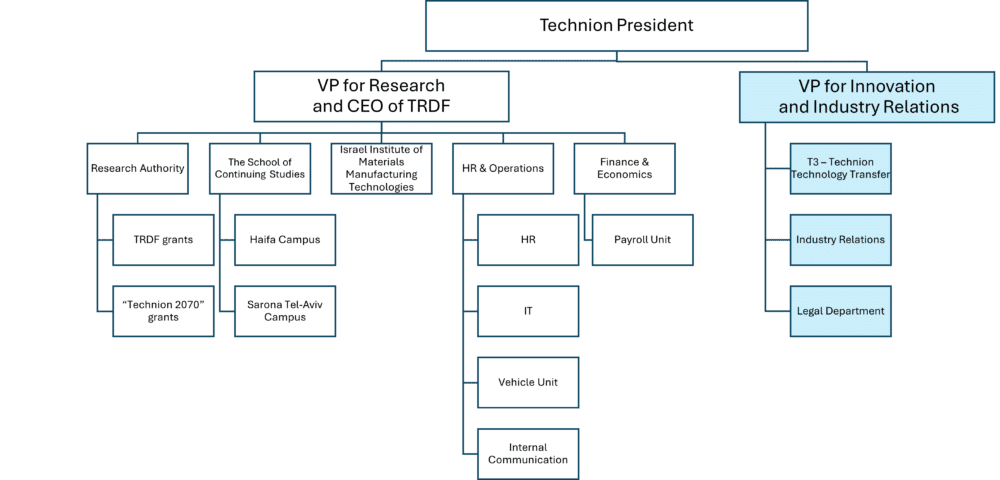
Structure chart TRDF


